License Plate Recognition (LPR)
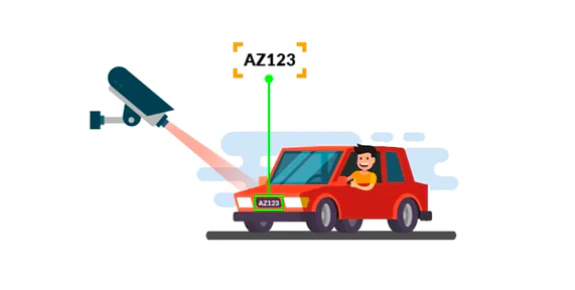
Plate condition and obstruction
Anything between the camera and the plate can reduces the read rate confidence.- Mud, salt spray, and road film: common in winter and on unpaved roads. A layer of dirt or debris can defeat the plate’s retroreflective sheeting, making it illegible even to the eye.
- Snow and slush: accumulates in the recessed plate pocket on many vehicles and can cover characters entirely after a single storm.
- License plate covers: tinted and smoked covers reduce contrast. Even clear covers can glare or reflect internally, washing out characters under floodlights or direct sun.
- Plate frames: dealer, novelty, and decorative frames often crop the top or bottom row of characters, or obscure elements the AI uses to identify the plate format.
- Physical obstructions: trailer hitches, ball mounts, bike and cargo racks, rear-mounted spare tires, and towed equipment can block part or all of the plate.
- Damage and age: bent, cracked, or repainted plates return lower confidence, as do older plates whose retroreflective sheeting has degraded.
- Stickers and decals: bumper sticker clutter around the plate gives the system competing high-contrast text to lock onto, lowering confidence.
Plate content and format
Some plates are harder to read because of what’s on them, not their condition.- Ambiguous characters: our AI is tuned to resolve most ambiguity, but character pairs
0/O,1/I,8/B,5/S,2/Z,6/G, andD/Ocause most single-character misreads; for example,SD0Gread asSDOG. These usually produce a near match rather than a no-read, so they surface as a customer whose plate “sometimes works.” - Vanity plates: short strings, stacked characters, and state-specific symbols lower confidence. Some states allow
&,+, and-, so a plate like+M&W-can be hard to read reliably. - Temporary paper tags: dealer tags have no retroreflective layer, fade and curl in sun and rain, and are often taped inside the rear window; these will not read reliably or at all.
Mounting and optical geometry
- Missing front plates: many states don’t require one. Front-facing-only installations won’t read these vehicles at all; an RFID reader is needed instead.
- Glare: a frequent cause of intermittent daytime failures, and easy to miss since it’s time-of-day specific. Sources include:
- Low sun angle at dawn and dusk aimed into the camera lens.
- Windshield sun shades and reflective dash panels bouncing light back toward the camera.
- Wet pavement reflecting site lighting or sunlight.
- Rear-mounted light bars and high-output reverse lamps saturating the camera’s exposure.
When a plate cannot be read
- Site staff
- Installer
- Look up the member by name, plate number, or phone number, and admit them.
- If the plate is dirty, snow-covered, or behind a plate cover, mention it; a quick wipe often resolves it.
- If the vehicle has a temporary tag, confirm whether permanent plates have been issued and update the account.
- If the same vehicle fails repeatedly while others read fine, add a secondary ID method such as RFID.
Radio Frequency Identification (RFID)
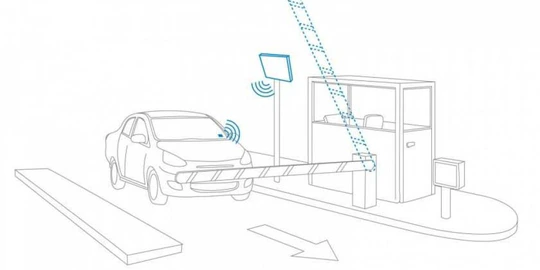
Why some windshields block tags
Many vehicles use RFID-blocking glass; athermic, solar-reflective, or heated windshields, with a microscopically thin metallic layer bonded within the glass to reflect infrared heat or carry defrost current. That same layer attenuates the radio waves an RFID reader uses, so a tag mounted behind it may read weakly, intermittently, or not at all. The standard tag location is the bottom driver-side corner of the windshield, clear of defroster lines and outside the wiper rest area. Since this sits at the windshield perimeter, it often falls on or beside the black dot frit band, that’s expected and not a problem, since the ceramic dots pass RF. The metallic coating is what blocks the tag. On affected vehicles, look for a coating-free window. Manufacturers usually omit the metallic coating in one small area so signals can pass; its position varies by model and glass supplier, and it’s commonly behind or beside the mirror rather than at the bottom corner. Some vehicles mark this spot, most don’t, so test a tag before committing to a location. Where the OEM owner’s manual specifies a transponder location, follow that over general guidance.Vehicles that may require alternate tag placement
The vehicles below are known to use RFID-blocking technology in at least some trims. Coverage varies by trim and glass supplier, and a replacement windshield may not match the original, so confirm on the vehicle in front of you rather than relying on the table alone.Vehicles with metallized or heated windshields
Vehicles with metallized or heated windshields
- Roof-mounted equipment: light bars, roof baskets, and similar accessories can block or interfere with the RFID signal.
- Upright windshields: vehicles with a near-vertical windshield, such as the Jeep Wrangler, Toyota FJ Cruiser and 4Runner, Lexus GX, Mercedes-Benz G-Class, and full-size vans, can also cause RFID failures.
Reader and site interference
Some RFID failures originate at the reader or the site instead of the vehicle.- Reader height, angle, and aim relative to typical tag position, especially in lanes serving both passenger cars and lifted trucks.
- Cross-reads from the adjacent lane or the next vehicle in the lane.
- RF noise from variable frequency drives, motor controllers, LED lighting drivers, and pump equipment.
Sites running LPR and RFID together get the most benefit from enrolling both identifiers on an account. Most single-method failures, a dirty plate or RFID blocking windshield, don’t affect the other method, so accounts carrying both see fewer failed entries than accounts carrying one.